








ABE NEWS | August 30, 2026
The United States and Iran have exchanged direct military strikes again, abruptly ending weeks of relative restraint and threatening to push the Middle East back into another dangerous phase of a conflict that has already shaken global energy markets and disrupted one of the world’s most important shipping routes.
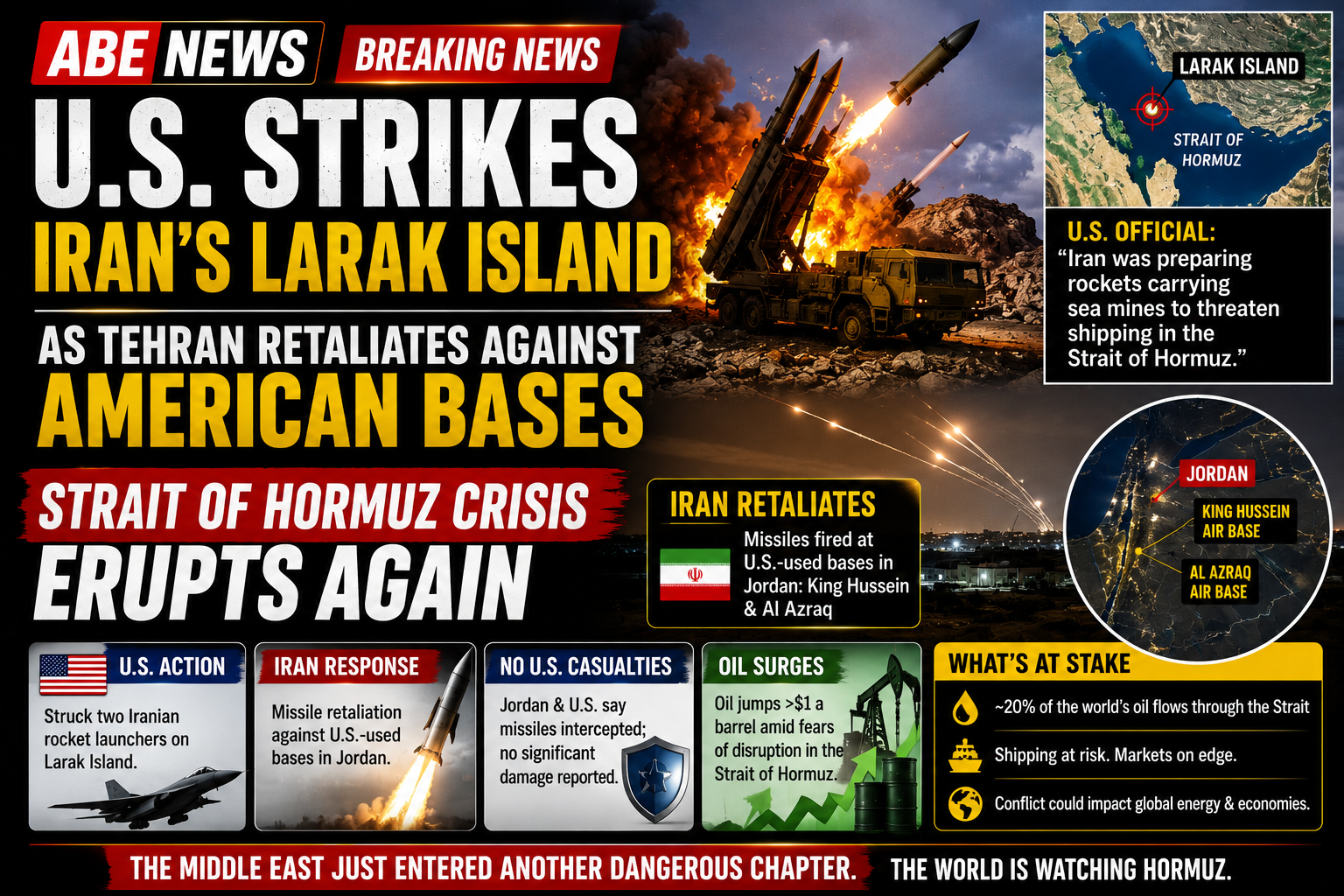
U.S. forces struck two Iranian rocket launchers on Larak Island, a strategically positioned island inside the Strait of Hormuz, on Sunday after American officials said members of Iran’s Islamic Revolutionary Guard Corps were preparing to launch rockets carrying sea mines into the waterway.
It was the first known American military strike inside Iran since late July.
Iran responded within hours.
The Revolutionary Guards said they launched ballistic missiles against King Hussein and Al Azraq airbases in Jordan, facilities used by U.S. forces, describing the attacks as retaliation for the American operation.
Jordan said its air defences intercepted eight missiles fired from Iran. U.S. reporting indicated that the incoming missiles were intercepted and that there had been no significant damage or American casualties at the bases in the initial assessment.
But the exchange has shattered the fragile military lull that had developed over recent weeks.
And because the confrontation is once again centred on the Strait of Hormuz, the consequences could reach far beyond Iran, Jordan and the United States.
Oil prices immediately moved higher.
Shipping companies are watching the waterway again.
And after months of conflict, sanctions, attacks and negotiations, the world is confronting the possibility that the Hormuz crisis is entering another escalation cycle.
WHY THE UNITED STATES STRUCK LARAK ISLAND
The American attack was unusually specific.
According to U.S. Central Command, Revolutionary Guard forces had been observed preparing two rocket launchers capable of firing rockets carrying sea mines into the Strait of Hormuz.
Washington characterized the operation as a limited and precise strike intended to eliminate an imminent threat to commercial shipping.
The United States had only recently completed efforts to clear mines from the main international shipping route through the strait.
That made the reported Iranian activity particularly significant.
If new mines had been successfully deployed, commercial vessels attempting to return to the waterway could again have faced potentially lethal risks.
Larak Island’s geography makes the location especially important.
The small Iranian island sits near Bandar Abbas at the entrance to the Gulf, overlooking shipping routes through the Strait of Hormuz.
That places it close to one of the most strategically important pieces of water on Earth.
Before the current conflict, roughly one-fifth of the world’s oil supply passed through the Strait of Hormuz.
Oil from Saudi Arabia, Iraq, Kuwait, the United Arab Emirates and other Gulf producers relies heavily on the route to reach international markets.
Any sustained disruption therefore becomes a global economic event.
The United States says that is precisely why it acted.
Washington’s position is that Iran was preparing to threaten commercial navigation again and that American forces destroyed the launchers before the mines could be deployed.
Iran sees the operation very differently.
IRAN SAYS PEOPLE WERE KILLED
Iran’s Revolutionary Guards said the American strike killed and wounded Iranian fighters and civilians.
Iranian media described the attack as a drone strike.
The Guards vowed that the United States would face retaliation, accusing Washington of committing another act of aggression against Iranian territory.
That threat quickly became action.
Iran said its forces fired ballistic missiles toward the King Hussein and Al Azraq bases in Jordan, both of which are used by American forces.
The Revolutionary Guards claimed that technical infrastructure, maintenance facilities and fighter-aircraft positions were targeted.
But there is an important difference between Iran’s claims and the initial assessments from the other side.
Iranian state media claimed significant damage.
Jordan and U.S.-linked reporting indicated that the missiles were intercepted and that the bases had not suffered significant impact.
There were no immediate reports of American casualties.
Those competing accounts will require further verification.
What is already clear, however, is that Iran chose direct military retaliation.
That raises the risk of another American response.
THE MILITARY LULL IS OVER
The timing matters.
The United States had not conducted a known strike inside Iran since late July.
After months of direct confrontation, the Trump administration had increasingly shifted toward economic pressure, using sanctions and financial restrictions to squeeze Tehran rather than relying continuously on military operations.
U.S. Treasury Secretary Scott Bessent said Sunday that Washington is preparing additional secondary sanctions against Iran, potentially on a weekly basis, with banks expected to be among the first targets.
That suggested the administration was attempting to increase the economic cost of Iranian resistance without immediately returning to a large-scale bombing campaign.
Sunday changed that calculation.
American forces have now attacked Iranian territory.
Iran has retaliated against sites used by American forces.
Both sides have demonstrated that the military option remains active.
The question is whether they stop here.
WHY SEA MINES MATTER SO MUCH
Sea mines are relatively inexpensive weapons capable of creating enormous economic consequences.
A country does not necessarily need to sink dozens of tankers to disrupt a major shipping route.
It only needs to make shipowners believe their vessels could be hit.
A tanker worth tens or hundreds of millions of dollars carrying an enormous cargo of oil cannot casually enter waters believed to contain mines.
Insurance premiums rise.
Crews become reluctant to sail.
Shipping companies reroute vessels where possible.
Governments deploy naval forces.
Commodity traders begin pricing potential shortages.
That is why the struggle over the Strait of Hormuz has repeatedly produced consequences far larger than the individual military operations taking place there.
Iran’s geographic position gives it enormous leverage.
The strait is narrow.
Iran sits along its northern side.
And Tehran possesses missiles, drones, naval forces and mines capable of threatening shipping.
The United States, meanwhile, has made maintaining freedom of navigation through the waterway one of its central objectives.
Those positions create a dangerous collision.
Iran views the strait as strategic leverage.
Washington views attempts to close or mine it as a threat to global commerce.
Larak Island sits directly in the middle of that confrontation.
OIL MARKETS REACT IMMEDIATELY
The economic consequences began appearing almost immediately.
Oil prices jumped more than $1 a barrel as Asian trading began following news of the American attack and Iranian retaliation.
Brent crude climbed above $89 a barrel in early trading, while U.S. West Texas Intermediate rose above $84.
The move reflects a familiar fear.
If fighting around Hormuz intensifies, how much oil will actually be able to leave the Gulf?
The market has already spent months trying to answer that question.
Shipping through the strait remains far below normal levels.
Visible commodity-vessel traffic over the weekend dropped to roughly five vessels per day as shipping companies remained cautious about the possibility of attacks.
Negotiations aimed at fully reopening the waterway have struggled to produce a lasting solution.
Oman has played a mediation role.
But Tehran continues to insist that any reopening must occur under arrangements acceptable to Iran.
Washington rejects the idea that Iran should be able to determine who can safely navigate an international shipping route.
That dispute has never truly been resolved.
Sunday’s attack has now made it harder.
WHY HORMUZ CAN MOVE THE GLOBAL ECONOMY
The Strait of Hormuz is not simply a Middle Eastern security issue.
It is an economic pressure point for the entire world.
Before the war, approximately one-fifth of global oil consumption passed through the waterway.
Large quantities of liquefied natural gas also move through the region.
That means disruption can affect fuel prices in Toronto, transportation costs in Europe, manufacturing expenses in Asia and inflation across developing economies thousands of kilometres from the fighting.
Higher oil prices eventually feed into almost everything.
Airline fuel becomes more expensive.
Trucking costs rise.
Shipping becomes more costly.
Factories pay more for energy.
Consumers spend more at gas stations.
Governments face renewed inflation pressure.
Central banks then have to consider whether energy-driven inflation could interfere with interest-rate policy.
That is why a military strike on two launchers located on a small Iranian island can immediately attract the attention of traders around the world.
The weapons may be local.
The economics are global.
TRUMP’S VENEZUELA STRATEGY NOW LOOKS EVEN MORE IMPORTANT
The renewed Hormuz confrontation also intersects with another enormous energy development.
President Donald Trump said this weekend that the United States has secured majority control over more than 65 billion barrels of Venezuela’s proven oil reserves through a new investment and operating framework.
The administration has also said Venezuelan production could help replenish the U.S. Strategic Petroleum Reserve.
That announcement already represented a major shift in American energy strategy.
The renewed Iranian confrontation gives it additional significance.
If Persian Gulf supplies remain vulnerable, Washington has a strong incentive to increase production elsewhere.
Venezuela possesses the world’s largest proven oil reserves.
The United States is the world’s largest oil producer.
Canada remains one of America’s most important energy suppliers.
Taken together, the Western Hemisphere could become increasingly important to Washington’s attempt to insulate itself from instability around the Gulf.
The connection is becoming difficult to ignore.
The United States is confronting Iran over one of the world’s most important oil corridors while simultaneously trying to expand access to one of the world’s largest oil reserves.
Energy and national security are becoming deeply intertwined.
IRAN STILL HOLDS A POWERFUL CARD
Iran cannot match the United States conventionally.
The American military possesses vastly greater air power, naval capabilities, intelligence systems and global reach.
But Iran does not need military parity to create enormous costs.
Its strategy has long relied on asymmetric pressure.
Missiles.
Drones.
Sea mines.
Regional allies.
Attacks on infrastructure.
Threats to shipping.
Those tools allow Tehran to create risk without defeating the United States in a conventional military confrontation.
The Strait of Hormuz is perhaps the most powerful example.
Iran does not have to permanently close the strait.
It only has to make passage dangerous enough that markets become nervous.
That nervousness itself has economic value.
Every rise in oil prices creates political pressure on governments dependent on imported energy.
Every disruption to shipping creates costs for companies.
Every American military deployment requires resources.
That is part of Tehran’s leverage.
BUT IRAN IS ALSO UNDER ENORMOUS PRESSURE
Iran’s position should not be mistaken for strength without limits.
Months of conflict have damaged the country.
Sanctions continue to weigh heavily on its economy.
Foreign trade has weakened.
Inflation remains severe.
Military infrastructure has repeatedly been targeted.
The country has also endured significant political disruption following the death of Supreme Leader Ayatollah Ali Khamenei earlier in the conflict.
Washington is now attempting to intensify that economic pressure further.
Bessent’s announcement that new secondary sanctions could be rolled out regularly suggests the United States intends to make doing business with Iran increasingly expensive for foreign companies and financial institutions.
That creates another layer to the confrontation.
America is applying economic pressure.
Iran is using geographical and military pressure.
Hormuz is where those strategies collide.
JORDAN IS ONCE AGAIN CAUGHT IN THE MIDDLE
Iran’s decision to fire toward U.S.-used bases in Jordan also highlights the danger facing American partners across the Middle East.
Jordan is not a direct party to the U.S.–Iran conflict in the same way as Washington and Tehran.
But American forces operate from Jordanian territory.
That makes the country vulnerable whenever Iran decides to retaliate against U.S. military infrastructure.
Jordanian air defences intercepted the incoming missiles Sunday.
But every Iranian attack carries the risk that debris, interception failures or targeting errors could kill Jordanians.
That could create domestic and regional political consequences.
Other Gulf countries face similar concerns.
American military facilities are distributed across Bahrain, Qatar, Kuwait, Saudi Arabia and elsewhere in the region.
During previous phases of the conflict, Iran has targeted U.S.-linked infrastructure across several of those countries.
Every new escalation therefore risks widening the geographical battlefield.
THE NEXT FEW HOURS MATTER
There are several things to watch immediately.
The first is whether the United States retaliates for Iran’s missile attack.
If Washington considers the Iranian response contained and no American personnel were killed, the administration could decide not to escalate further.
But if subsequent assessments reveal significant damage or casualties, pressure for another military response would increase sharply.
The second is Iran’s activity around the Strait of Hormuz.
If Revolutionary Guard forces attempt to deploy additional mines or target commercial vessels, the United States has already demonstrated that it is prepared to strike Iranian forces directly.
The third is shipping traffic.
Any major decline in tanker movement would increase concerns about energy supply and could push oil prices higher.
The fourth is diplomacy.
Oman and other regional intermediaries have spent months trying to establish arrangements that could restore safer navigation through Hormuz.
Another military exchange makes their task considerably harder.
And finally, markets.
Oil’s first move has been upward.
A sustained escalation could produce something much larger.
🔴 THE ABE NEWS TAKE
The most dangerous part of Sunday’s confrontation is not the destruction of two rocket launchers.
It is how quickly one military action produced another.
The United States says Iranian forces were preparing to put new mines into the Strait of Hormuz.
Washington struck first.
Iran promised retaliation.
Within hours, ballistic missiles were flying toward bases used by American forces in Jordan.
That is how escalation works.
Each side describes its own action as necessary.
Each side describes the other’s action as aggression.
Each retaliation becomes justification for the next.
And sitting between them is a narrow waterway carrying energy on which much of the global economy depends.
The world has already learned what disruption in Hormuz can do.
Oil prices rise.
Shipping slows.
Insurance costs explode.
Businesses pay more.
Consumers eventually pay more.
The danger tonight is that the fragile reduction in military activity seen over recent weeks may have been only a pause.
The United States has demonstrated that it will attack Iranian forces if it believes Hormuz is being mined.
Iran has demonstrated that an American strike on its territory will still produce direct retaliation against U.S. military sites.
Neither side appears willing to surrender its central position.
That leaves the Strait of Hormuz exactly where it has been for months:
at the centre of a military confrontation with the power to become a global economic crisis.
Two launchers were struck on Larak Island.
Missiles were fired toward Jordan.
Oil immediately moved higher.
The next decision belongs to Washington and Tehran.
And tonight, the world is once again watching the Strait.
ABE NEWS
Business. Money. Style. The News.
Understand More. Think Bigger.