









ABE NEWS | SUNDAY, AUGUST 23, 2026
The Democratic Republic of Congo is facing an Ebola crisis on a scale the country has never experienced before.
More than 5,000 confirmed infections.
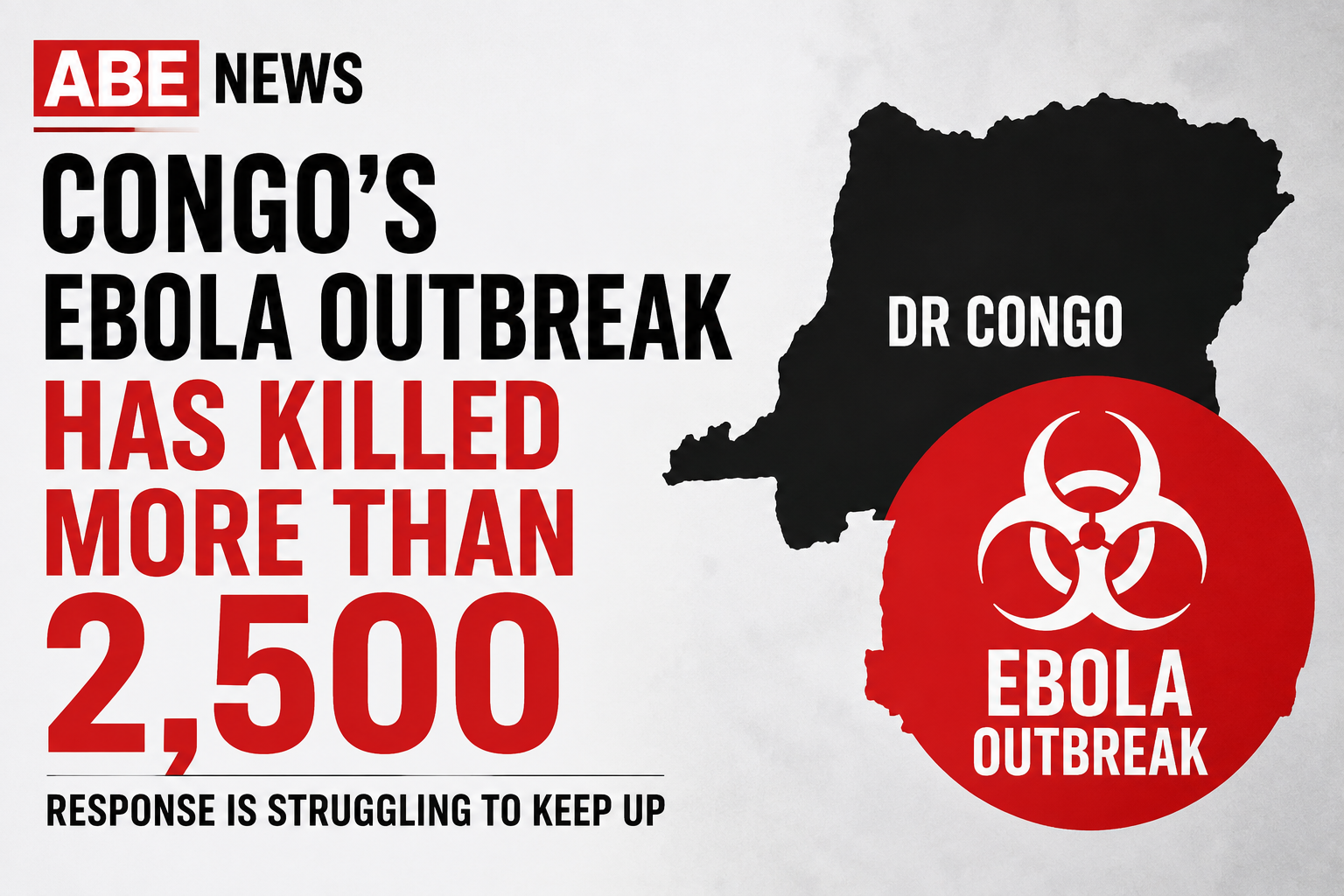
More than 2,500 deaths.
Six provinces affected.
Dozens of health zones reporting cases.
And health authorities are warning that transmission has still not peaked.
On Sunday, the crisis drew a new appeal from the Vatican.
Speaking to pilgrims gathered in St. Peter’s Square, Pope Leo urged the international community to help Congo contain an epidemic that is already the country’s largest Ebola outbreak on record by confirmed cases.
But this isn’t simply a story about a dangerous virus.
It is also a story about what happens when an epidemic collides with armed conflict, damaged healthcare infrastructure, attacks on medical workers, population displacement and a virus strain for which there is no specifically approved vaccine or treatment.
And that combination is making this outbreak extraordinarily difficult to stop.
Congo Has Faced Ebola Before. This Time Is Different.
The Democratic Republic of Congo is no stranger to Ebola.
This is the country’s 17th Ebola epidemic.
Its 2018–2020 outbreak was previously the country’s worst, infecting thousands and killing more than 2,000 people.
The current outbreak has already surpassed it in confirmed cases.
By August 20, Congo had reported 5,290 confirmed infections and 2,516 deaths, according to figures compiled by the European Centre for Disease Prevention and Control.
By Saturday, AP reported newer government figures showing 5,375 confirmed cases and 2,557 deaths across six provinces.
That means almost half of confirmed patients have died.
And this outbreak has another worrying characteristic.
It is being caused by the Bundibugyo virus, a rarer Ebola species.
Unlike the Zaire species responsible for several previous major outbreaks, there is currently no approved vaccine specifically targeting Bundibugyo and no approved targeted treatment for it.
That makes one of the world’s most dangerous infectious diseases even harder to fight.
The Virus Is Moving Across a Huge Area
This isn’t an outbreak contained inside one city.
As of August 20, 56 of 151 health zones across six affected provinces had reported cases.
Ituri is by far the hardest-hit province, with more than 4,400 confirmed infections, but cases have also been reported in North Kivu, South Kivu, Haut-Uele, Tshopo and Bas-Uele.
That geographic spread matters enormously.
Containing Ebola requires finding infected people quickly, isolating them, identifying everyone they have been in contact with and monitoring those contacts for symptoms.
That is difficult in a well-functioning healthcare system.
It becomes far harder when patients are spread across large areas with poor roads, limited medical infrastructure and populations already displaced by violence.
Ebola doesn’t spread through the air like influenza.
Transmission generally requires direct contact with the blood or other bodily fluids of an infected person, or contaminated materials.
That means outbreaks can be stopped.
But doing so requires an effective public-health response.
And that is precisely where Congo is struggling.
Doctors Are Fighting a Virus Inside a Conflict Zone
Parts of eastern Congo have experienced years of armed conflict involving government forces and multiple armed groups.
Some of the areas now confronting Ebola are also dealing with that instability.
AP reports that rebel groups control important cities in the outbreak’s hotspot, while attacks on medical personnel and healthcare facilities have complicated the response. Population displacement and highly mobile workers are making contact tracing more difficult as well.
There is also community resistance.
Fear and misinformation can be devastating during an Ebola outbreak.
A person who distrusts medical workers may avoid treatment.
A family may hide an infection.
Traditional burial practices can bring relatives into direct contact with the body of someone who died from Ebola, when the virus can still be highly infectious.
And when communities distrust the institutions trying to help them, even scientifically sound interventions become harder to implement.
That explains part of Pope Leo’s message Sunday.
He didn’t merely call for more international assistance.
He specifically emphasized involving local communities in prevention efforts.
That distinction matters.
An epidemic isn’t defeated only in laboratories and hospitals.
It is defeated when people understand what is happening and trust the response enough to participate in it.
There May Be Some Hope From an Existing Vaccine
There was an important development this weekend.
Congo received 16,250 doses of the Ervebo Ebola vaccine late Friday as part of a planned allocation of 70,000 doses from the international emergency stockpile.
But there’s a catch.
Ervebo is licensed for outbreaks caused by Zaire ebolavirus.
This outbreak is Bundibugyo.
Scientists therefore don’t yet know whether Ervebo will protect humans against the strain currently spreading through Congo.
Early laboratory and animal evidence suggests it may provide some protection, however, and WHO and Africa CDC are supporting its carefully monitored use.
Of the 70,000 allocated doses, 20,000 are intended for a Phase 3 clinical trial designed to determine whether the vaccine actually works against Bundibugyo.
Another 50,000 doses are intended for frontline and healthcare workers under current recommendations.
That creates an unusual situation.
Health authorities are simultaneously trying to stop an emergency and generate the scientific evidence needed to determine whether one of their most promising tools actually works against this particular virus.
The answer could matter far beyond Congo.
This Is Now a Global Health Story
The overwhelming majority of cases remain inside Congo.
But the outbreak has already demonstrated that national borders cannot completely contain infectious disease.
Imported cases linked to affected areas in Congo have previously been identified abroad, including people medically evacuated for treatment.
ECDC nevertheless assesses the likelihood of infection for people living in the European Union and European Economic Area as very low.
That distinction is important.
A severe epidemic deserves international attention without creating unnecessary panic in places where individual risk remains extremely low.
The global concern isn’t that Ebola is suddenly about to spread uncontrollably through every major city.
The concern is that thousands of people are dying right now, while the conditions necessary to contain the disease remain extraordinarily difficult.
And if the world waits until an outbreak crosses more borders before treating it as an international emergency, it has already waited too long.
The Numbers Could Still Get Worse
Perhaps the most worrying part of the current situation is that authorities don’t believe the outbreak has necessarily reached its peak.
AP reported Africa CDC data indicating transmission could still increase substantially.
That’s why the next few weeks matter.
More vaccines are expected.
Contact tracing needs to expand.
Healthcare workers need protection.
Treatment and isolation capacity need to keep growing.
And communities need reliable information from people they trust.
Every delay gives the virus more opportunities to move.
The world learned this lesson during the devastating 2014–2016 West African Ebola epidemic, which killed more than 11,000 people.
By the time an epidemic looks catastrophic from thousands of kilometres away, the opportunity to contain it cheaply and quickly may already have disappeared.
🔴 THE ABE NEWS TAKE
It’s tempting to look at Congo’s Ebola crisis and see a medical problem.
It isn’t only that.
This outbreak demonstrates how a disease can exploit almost every weakness surrounding it.
Weak infrastructure makes patients harder to reach.
Conflict moves populations and restricts healthcare access.
Attacks on medical workers weaken the response.
Distrust makes contact tracing harder.
A lack of proven strain-specific vaccines and treatments removes tools doctors might otherwise rely on.
And insufficient international attention allows all those problems to compound.
There is also a broader lesson here.
The world often spends enormous amounts responding to crises after they become impossible to ignore.
Public health works best much earlier.
Surveillance.
Hospitals.
Laboratories.
Trained workers.
Community trust.
Vaccines.
Emergency stockpiles.
Those investments rarely produce dramatic headlines when they’re working.
But when they’re missing, the consequences eventually do.
More than 2,500 people are already dead in Congo.
The country has fought Ebola repeatedly and defeated it repeatedly.
It can defeat this outbreak too.
But the longer the virus moves faster than the response, the more expensive that victory becomes—in money, resources and, most importantly, human lives.
That’s why Sunday’s international appeal matters.
The question is no longer whether Congo has a serious Ebola outbreak.
It already has the largest in its history.
The question is whether the international response can finally begin moving faster than the virus.
ABE NEWS
Business. Money. Style. The News.
Understand More. Think Bigger.