








ABE NEWS | TUESDAY, AUGUST 25, 2026
The trade confrontation between Canada and the United States has moved directly into one of the most important industries connecting the two economies.
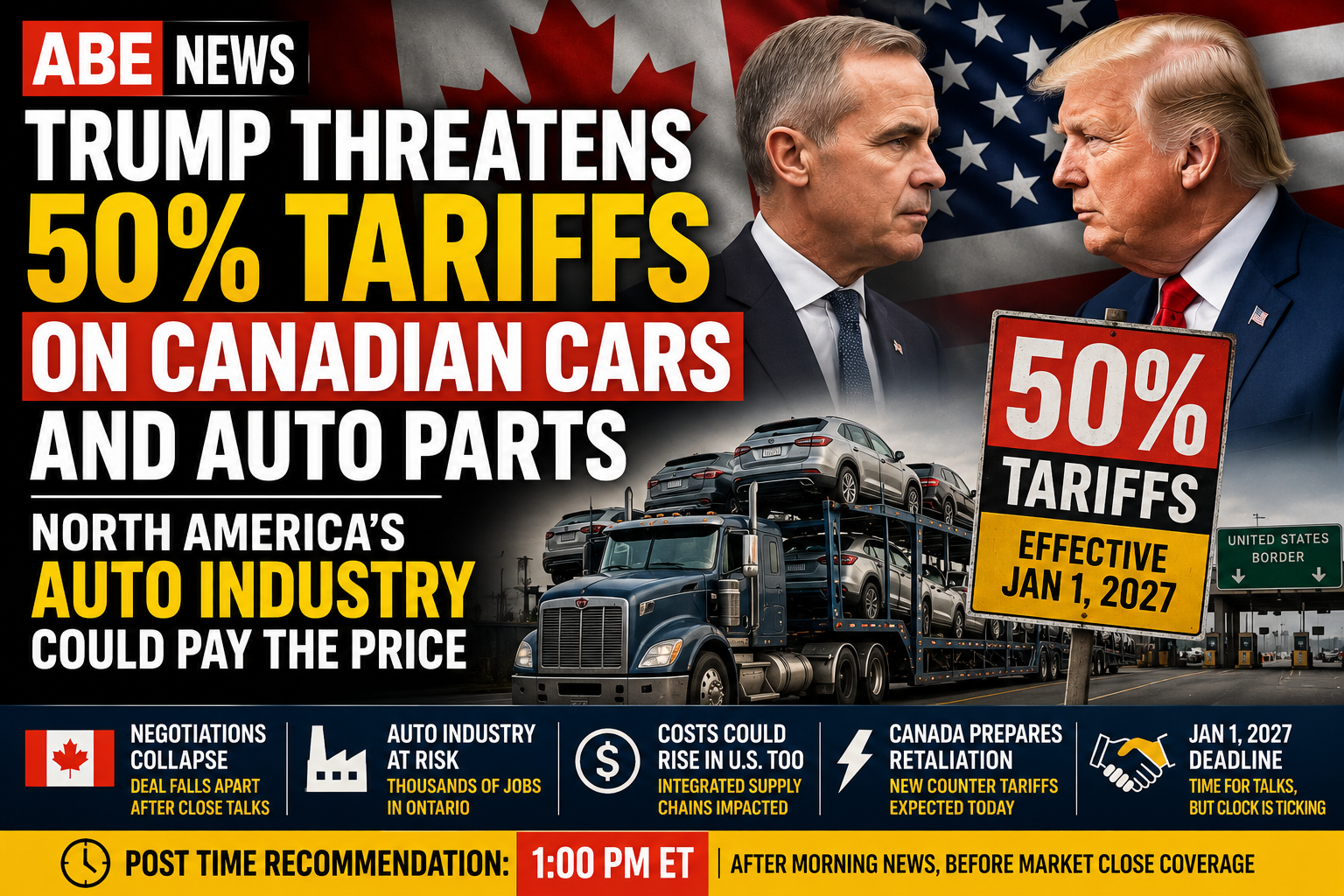
President Donald Trump is threatening to impose 50% tariffs on Canadian-made cars, trucks and automotive parts beginning January 1, 2027, dramatically escalating the dispute after trade negotiations between Washington and Ottawa collapsed last week. The threat would double the current headline U.S. tariff on Canadian vehicles and, crucially, extend the 50% rate to auto parts that have enjoyed important exemptions under the existing North American trade framework.
For Canada, the threat strikes directly at Ontario’s manufacturing heartland. But this isn’t simply a Canadian problem. The North American auto industry has spent decades developing a supply chain in which parts, components and partially assembled vehicles routinely move between Canada and the United States before a finished vehicle reaches a dealership. A tariff designed to punish Canadian production could therefore increase costs inside American factories as well.
That is what makes this escalation different from another argument over tariffs. Washington is threatening to put a much larger barrier through an industry that was deliberately built to operate across the border.
And Canada is preparing to hit back.
The Deal Was Apparently Much Closer Than It Looks Now
Only days ago, Canada and the United States were negotiating an agreement that could have significantly reduced some of the tariffs already weighing on cross-border trade. According to Reuters, the proposal under discussion would have lowered the headline tariff on Canadian cars and light-duty trucks from 25% to 15%, while cutting U.S. tariffs on Canadian steel and aluminum from 50% to 25%.
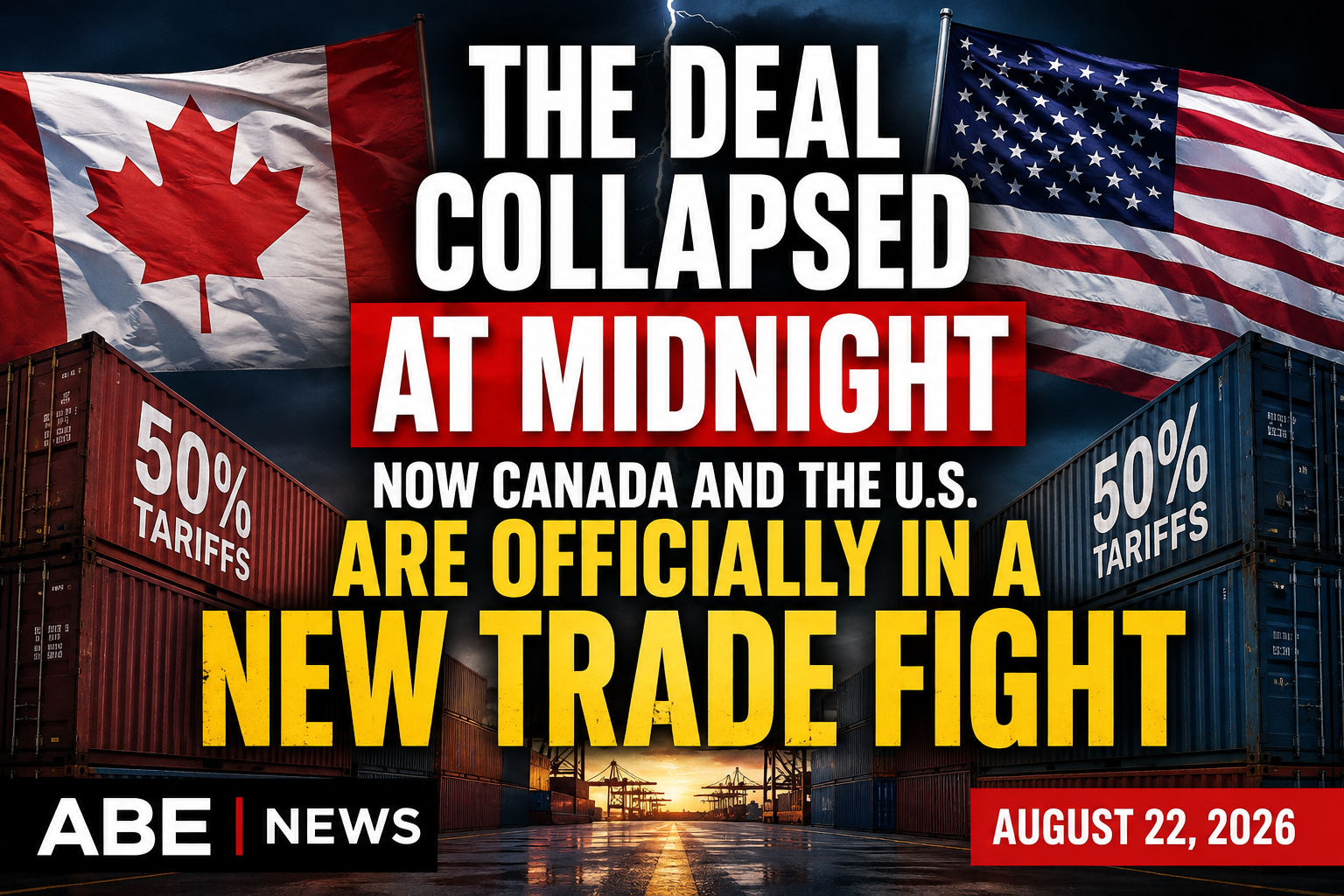
But the negotiations collapsed Friday after the two governments failed to resolve several disagreements, including whether tariff relief would extend to medium- and heavy-duty trucks. Canada walked away from the negotiations, and the relationship deteriorated rapidly from there.
Trump responded Monday by threatening the new 50% automotive tariffs. Prime Minister Mark Carney, meanwhile, said Canada remained open to a mutually beneficial agreement, but only if Washington approached the negotiations as a genuine partnership and respected Canadian sovereignty. Carney has gone considerably further in describing why Canada rejected the previous terms, arguing that American demands threatened major Canadian industries including autos, steel and aluminum.
This means the dispute is no longer only about the percentage written beside a tariff line. Both governments are increasingly describing it as a fight over what the future economic relationship between the two countries should look like.
Why 50% Would Be So Serious for Canada
Canada’s automotive industry is deeply concentrated in Ontario and supports a much larger ecosystem than the assembly plants themselves. Automakers including Ford, General Motors and Stellantis operate major Canadian facilities, while an extensive network of parts manufacturers, logistics companies, tool-and-die businesses and other suppliers depends on vehicle production.
The United States is overwhelmingly important to that system because Canadian factories don’t operate as an isolated national industry. They are part of an integrated North American manufacturing network.
Canada supplies approximately 13% of total U.S. vehicle and parts imports, according to Fitch Ratings data cited by Dow Jones. Analysts warn that imposing 50% tariffs could force a significant restructuring of Canadian automotive manufacturing and create lasting consequences for the country’s broader industrial base.
That helps explain why Canadian automotive stocks were hit after Trump’s announcement. Magna International fell about 4%, Linamar dropped 4.9%, and Martinrea International declined 6.3% as investors began pricing the possibility of a much more hostile environment for cross-border manufacturing.
The danger for Canada is straightforward. If a vehicle assembled in Ontario becomes dramatically more expensive to import into the United States than the same vehicle assembled in Michigan, automakers eventually have a powerful financial incentive to reconsider where future production and investment should go.
Trump made that objective explicit, telling manufacturers that if they build in the United States they will face zero tariffs.
That creates pressure not merely on today’s exports, but on tomorrow’s investment decisions.
But American Factories Don’t Operate Separately From Canada
There is a major complication with trying to use tariffs to move Canadian auto manufacturing south of the border: much of the industry on both sides is already intertwined.
A vehicle assembled in the United States can contain Canadian components. Those components may themselves contain American materials. During production, parts can cross the border multiple times before the final vehicle is completed.
That means putting a tariff on Canadian auto parts doesn’t necessarily punish only a Canadian company. It can increase the input costs of an American assembly plant that needs those parts to build vehicles in the United States.
Flavio Volpe, president of Canada’s Automotive Parts Manufacturers’ Association, warned that U.S. auto assembly depends on specific Canadian-made components and that production could halt without them.
That is the central contradiction of the tariff strategy. Washington wants companies to move production into the United States, but some American production already depends on Canadian factories. Replacing an established supplier isn’t necessarily as easy as finding another company and signing a contract. Automotive components have to meet technical specifications, safety standards and production schedules, while new facilities require capital, workers and time.
A 50% tariff could therefore create enormous pressure to reorganize the supply chain, but the transition itself could be expensive.
American Consumers Could Feel It Too
Tariffs are often described politically as something one country charges another country. Economically, the process is more complicated.
A U.S. tariff on a Canadian vehicle is collected from the importer bringing that product into the United States. Businesses then decide how much of that additional cost they can absorb and how much they need to pass through to dealerships and ultimately consumers.
That doesn’t mean every vehicle price automatically rises by exactly the tariff percentage. Automakers can change sourcing, absorb part of the cost, negotiate with suppliers or shift production. But the larger the tariff becomes, the harder it is to make the cost disappear.
The same problem applies to components. If an American factory pays more for a Canadian-made part it cannot quickly replace, its cost of manufacturing the finished vehicle rises.
This is why economists and industry representatives are warning that a prolonged Canada–U.S. trade confrontation could hurt businesses and workers on both sides of the border, rather than producing a clean division between one winner and one loser.
Canada Is Preparing Retaliation
Ottawa is not responding by accepting Washington’s terms.
Canada is expected to announce additional retaliatory measures Tuesday. Minister responsible for Canada–U.S. trade Dominic LeBlanc said this morning that announcing retaliatory tariffs was the government’s intention, arguing that Ottawa had warned Washington it would take steps to protect Canadian industries if negotiations failed.
Canada had already announced tariffs beginning September 8 targeting selected American products after Washington imposed 50% duties on about $20 billion of Canadian goods. The planned Canadian measures include sectors such as steel, dairy, appliances, agricultural equipment, pulp and paper, and electronics.
The approach may become more targeted as the confrontation develops. Carney has indicated that Canada may move away from simply matching American tariffs dollar for dollar and instead design retaliation around protecting Canadian workers and businesses. Finance Minister François-Philippe Champagne and other cabinet ministers are also expected to outline support for workers affected by the tariffs.
That distinction matters. A tariff war can become self-defeating if each government simply keeps increasing costs on products its own businesses and consumers need. Canada therefore has to decide where retaliation creates maximum negotiating pressure while minimizing damage at home.
Ontario Is Talking About Much Stronger Leverage
Ontario Premier Doug Ford is pushing for Canada to consider going further if Washington continues escalating.
Ford has raised Canada’s oil, electricity, potash and critical minerals as possible sources of leverage and said Ontario could increase the price of electricity exported south or potentially stop those exports. Ontario supplies electricity used by roughly 1.5 million U.S. homes and businesses, according to Ford.
This isn’t an entirely theoretical threat. Ontario previously imposed a 25% surcharge on electricity exports to Michigan, Minnesota and New York during an earlier stage of the trade confrontation. Trump responded by threatening to double tariffs on Canadian steel and aluminum, after which both sides stepped away from those measures.
Energy would represent a much more serious escalation because Canada is one of America’s most important energy suppliers. Ottawa has so far avoided targeting sensitive energy exports directly, but the fact that provincial leaders are openly discussing those options demonstrates how far the political relationship has deteriorated.
Once governments begin moving beyond consumer products and toward strategically important energy and industrial inputs, a tariff dispute starts looking much more like a broader economic confrontation.
The Bigger Risk Is the North American Trade System
The automotive threat also arrives at a dangerous moment for the wider North American trading relationship.
Canada, the United States and Mexico have spent decades building production systems around the assumption that goods can move relatively freely across their borders. The current framework, the United States–Mexico–Canada Agreement, helped preserve much of that integration after replacing NAFTA.
But the future of that arrangement has become increasingly uncertain. Reuters notes that the U.S.–Canada confrontation could accelerate the weakening of USMCA, potentially replacing a relatively predictable continental framework with more complicated bilateral arrangements and annual uncertainty.
For companies deciding whether to spend billions building a factory, uncertainty itself can be damaging. A manufacturer doesn’t simply ask what the tariff is today. It needs to know what the rules could look like five, ten or twenty years from now.
If businesses stop believing that North America’s trade rules are durable, they may delay investments, redesign supply chains or build additional capacity elsewhere simply to reduce political risk.
That could ultimately matter more than any individual tariff.
The January Deadline Leaves Room for Negotiation
There is one reason not to assume the 50% automotive tariff is inevitable.
Trump set the proposed implementation date for January 1, 2027, leaving more than four months for the two governments to negotiate. Auto executives speaking anonymously to Reuters also noted that Trump has previously threatened tariffs that were later reduced or delayed and suggested the January deadline could be intended partly to bring Canada back to the negotiating table.
That possibility shouldn’t be dismissed. Tariff threats can function as negotiating leverage precisely because businesses and governments want to avoid them before they take effect.
U.S. Treasury Secretary Scott Bessent said Washington wants Canada to return to negotiations in good faith. Carney has likewise said a mutually beneficial agreement remains possible if the United States approaches Canada as a partner.
So despite the increasingly hostile rhetoric, the door isn’t completely closed.
The problem is that the political cost of compromise is rising.
Each new threat makes backing down harder. Each retaliatory tariff creates another constituency demanding protection. Each personal attack makes the disagreement less technical and more political.
Eventually, governments can find themselves trapped by rhetoric that began as negotiating leverage.
🔴 THE ABE NEWS TAKE
A 50% tariff on Canadian automobiles sounds at first like a weapon aimed north.
The reality is considerably messier.
Canada and the United States didn’t build two completely separate auto industries. Over decades, they built something closer to one North American production system divided by an international border. Canadian plants depend on American customers, American factories depend on Canadian components, and companies have designed their supply chains around the assumption that those relationships will remain economically workable.
That is why a 50% tariff could inflict serious damage on Canada’s manufacturing base while simultaneously creating higher costs and production problems inside the United States.
Trump’s strategy is clear: make Canadian production expensive enough that companies have a powerful incentive to manufacture more vehicles and parts in America. Canada’s challenge is equally clear: defend an industry that supports thousands of jobs without launching retaliation that causes even more damage to Canadian businesses and consumers.
But the most consequential question extends beyond automobiles.
Can Canada and the United States still trust the economic system they built together?
Canada is America’s second-largest single-country trading partner, with bilateral trade reaching about $715 billion last year, according to U.S. Census Bureau figures cited by Reuters. A prolonged confrontation between two economies that interconnected cannot remain neatly contained inside one industry.
The January 1 deadline means there is still time for negotiation.
That may ultimately be exactly why the deadline exists.
But if no agreement arrives and the 50% automotive tariffs actually take effect, the damage won’t stop when a Canadian-built vehicle reaches the American border.
It will travel backward through factories, suppliers, workers and investment decisions on both sides.
And at that point, North America won’t simply be arguing about tariffs.
It will be deciding whether the integrated economy it spent decades building is still worth preserving.
ABE NEWS
Business. Money. Style. The News.
Understand More. Think Bigger.