









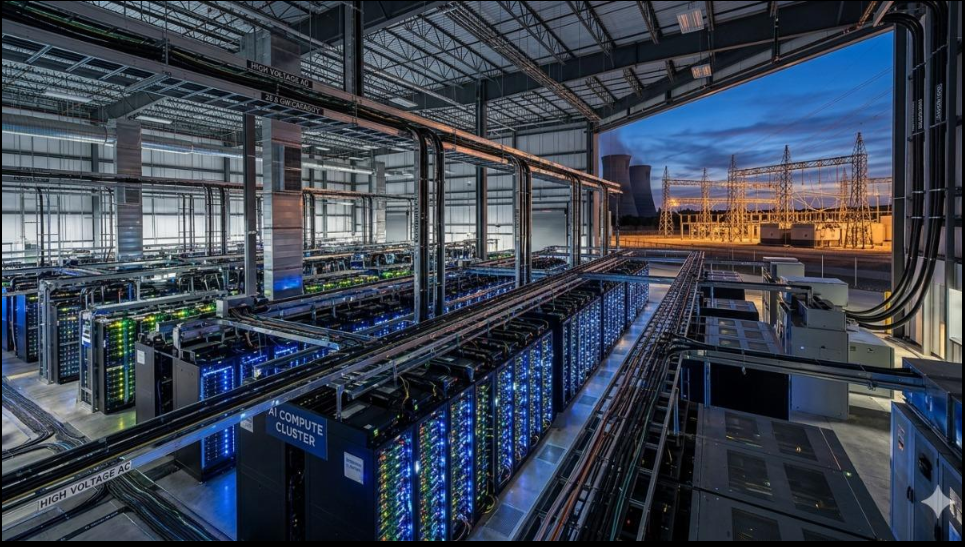
Artificial intelligence may feel like something that lives inside your phone or computer.
But behind AI tools are enormous buildings filled with powerful computers — and those computers need a lot of electricity.
That is creating a new challenge for the technology industry: How do we build enough computing power for AI without putting too much pressure on electricity systems?
The issue is becoming more important as companies continue investing in AI infrastructure.
Today, for example, Schneider Electric and AMD announced a new reference design aimed at high-density AI data centers, focusing on the power and cooling infrastructure needed for increasingly powerful AI systems.
But the bigger story isn’t just about those two companies.
It’s about the enormous infrastructure being built behind the AI revolution.
🖥️ First, What Is an AI Data Center?
Think of a data center as a giant computer building.
Inside are rows of servers that process and store information.
When millions of people use services such as AI assistants, cloud applications and online platforms, much of that computing happens inside data centers.
AI makes this especially demanding because training and operating advanced AI models can require large numbers of powerful processors.
Those processors also produce heat.
That means an AI data center needs more than computers. It may also need:
⚡ Large amounts of electricity
❄️ Powerful cooling systems
💾 Storage and memory
🌐 High-speed networking
🏗️ Specialized buildings and infrastructure
This is why the AI boom is becoming an energy story as much as a technology story.
⚡ Just How Much Electricity Are Data Centers Using?
Here’s where the numbers become interesting.
The International Energy Agency estimates that data centers consumed nearly 500 terawatt-hours of electricity in 2025, representing around 1.5% of global electricity consumption.
The IEA expects data-center electricity consumption to double by 2030.
That’s a huge increase in only a few years.
And it creates an important question:
Where will all that additional electricity come from?
Power grids weren’t originally designed around thousands of increasingly powerful AI processors operating around the clock.
As more facilities are built, governments, utilities and technology companies will have to think about how those facilities connect to the electricity grid.
💰 AI Is Creating Businesses Behind the Business
When people think about the AI boom, companies making AI models usually get most of the attention.
But there is another side to the story.
Someone has to build the infrastructure.
That creates opportunities for companies involved in:
Semiconductors — AI systems need powerful processors.
Electricity — Servers need reliable power 24 hours a day.
Cooling — Powerful processors generate significant heat.
Construction — New data centers require enormous physical facilities.
Networking — AI systems need to move massive amounts of information quickly.
Memory and storage — AI applications can require large amounts of data.
In other words, there could be an entire economy growing behind AI.
You may never see these businesses when you open an AI chatbot, but they help make the technology possible.
🌎 Why Should Regular People Care?
This isn’t only an issue for technology companies.
Large increases in electricity demand can affect decisions about where new power plants, transmission lines and other infrastructure are built.
Communities are also beginning to debate the amount of land, electricity and water that large data centers can require.
At the same time, these facilities can bring investment, construction projects and technology infrastructure to an area.
That creates a difficult balance.
Countries want to participate in the AI economy.
But they also need reliable and affordable electricity for homes and existing businesses.
🔮 What Happens Next?
The AI race may eventually become partly an energy race.
Having the best AI model won’t be enough if companies cannot find enough electricity and infrastructure to operate their computing systems efficiently.
That means some of the biggest winners from AI may not necessarily be chatbot companies.
They could also be businesses providing the chips, electricity, cooling, networking and buildings that keep AI running.
And that is something investors, businesses and governments will be watching closely.
🔥 ABE NEWS TAKEAWAY
AI doesn’t run on magic. It runs on computers — and computers need power.
As artificial intelligence expands, the world will need significantly more data-center infrastructure.
That means the AI boom isn’t just changing technology.
It could change energy, construction, business and investment too.
ABE NEWS
Business. Money. Style. The News.
Explained in 3 Minutes.