








ABE NEWS | August 28, 2026
Norway has lost its king.
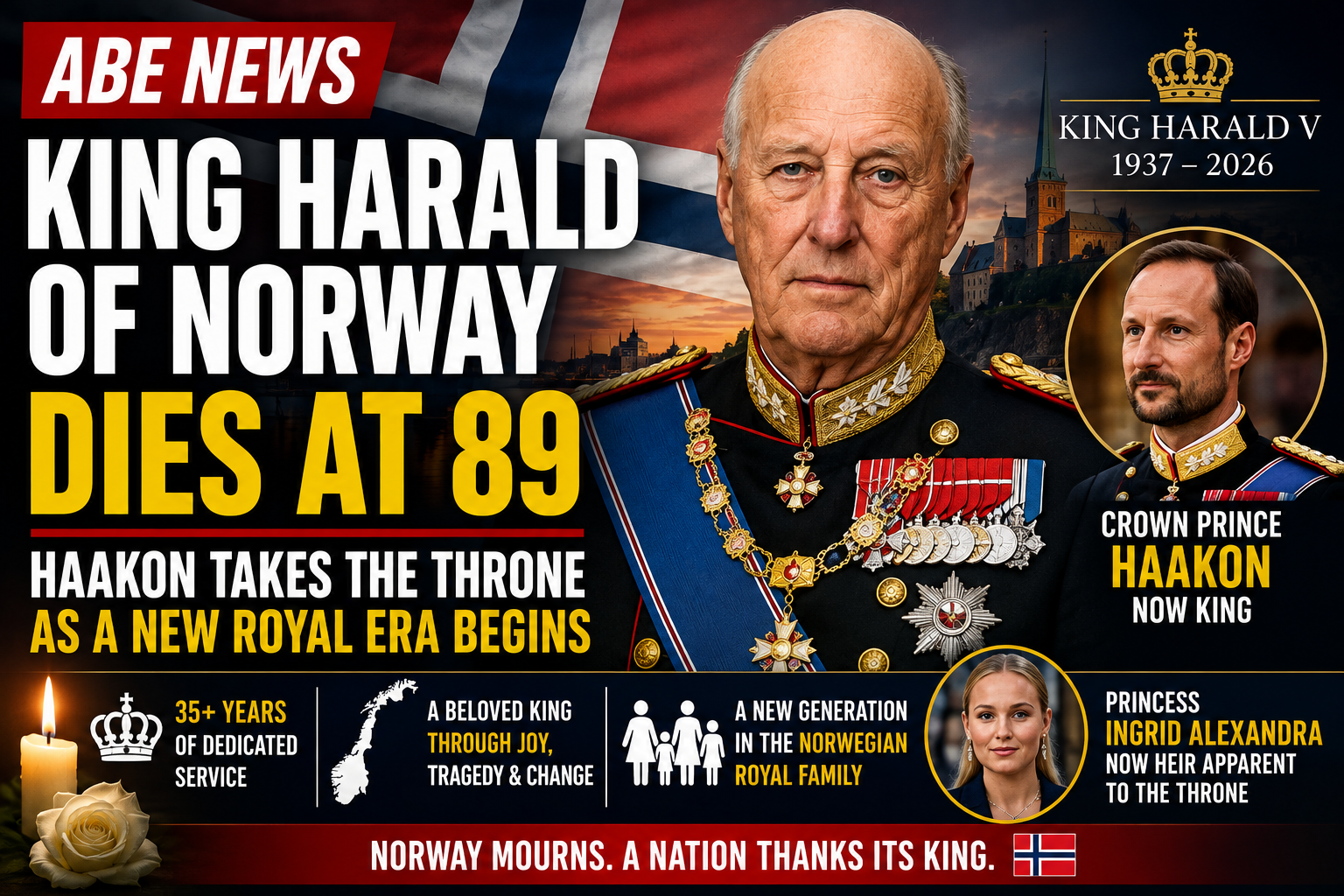
King Harald V, the country’s monarch for more than 35 years and one of Europe’s longest-serving heads of state, died Friday at the age of 89, bringing to an end a reign that spanned dramatic changes in Norwegian society and transformed him into one of the country’s most recognizable symbols of national unity.
The Norwegian Royal Court announced that Harald died peacefully at Oslo University Hospital Rikshospitalet at 6:35 a.m. on Friday, August 28, after his health had deteriorated during a serious illness.
His death immediately triggered a historic transition for the Norwegian monarchy.
Harald’s son, Crown Prince Haakon, has succeeded his father as King of Norway, beginning a new chapter for one of Europe’s oldest monarchies.
Norway now enters a period of mourning for a king who spent more than three decades representing the country at home and abroad — through national celebrations, political transitions, terrorist attacks, natural disasters and enormous social change.
For many Norwegians, Harald was more than the man wearing the crown.
He became a familiar and often reassuring presence across generations.
The King’s Final Days
Concern over Harald’s condition had been growing throughout the week.
The 89-year-old monarch had been hospitalized after developing serious health problems, including a bacterial infection in his bloodstream.
The Royal Court said earlier in the week that his health had deteriorated, and by Thursday officials described his condition as “very serious.”
Members of the royal family gathered around him as Norway waited anxiously for further news.
Crown Prince Haakon had already been serving as regent while his father was unable to perform his royal duties.
Then, early Friday morning, the announcement came.
Harald had died.
The Royal Court issued a brief statement confirming that the king had passed away peacefully in hospital.
The news quickly triggered an outpouring of grief across Norway and condolences from political leaders, royal families and international figures.
For a country of roughly 5.6 million people, the moment marks the end of an era.
A Reign That Began in 1991
Harald became king on January 17, 1991, following the death of his father, King Olav V.
He inherited a monarchy that was already deeply rooted in modern Norwegian identity but faced the same challenge confronting royal institutions across Europe: how to remain relevant in increasingly democratic, informal and rapidly changing societies.
Harald’s answer was not to make the monarchy louder.
It was largely to make it more accessible.
His constitutional powers were limited, with Norway functioning as a parliamentary democracy in which elected politicians exercise political authority.
But the king occupied a different kind of position.
He represented continuity.
He formally opened parliament, received ambassadors, presided over the Council of State, represented Norway internationally and performed ceremonial duties across the country.
Over time, however, his greatest influence arguably came from moments when ceremony gave way to national emotion.
The King Who Spoke When Norway Was Hurting
One of the defining moments of Harald’s reign came after the July 22, 2011 terrorist attacks, when a bombing in Oslo and mass shooting on Utøya island killed 77 people.
Norway was traumatized.
Harald became one of the public figures tasked with helping the country process its grief.
His response emphasized solidarity, democracy and compassion rather than fear.
The Royal Court itself describes the king as a figure who met Norwegians during both major celebrations and moments of profound sorrow.
After the 2011 attacks, that role became particularly visible.
It illustrated something fundamental about modern constitutional monarchy.
A monarch may have little direct political power while still possessing enormous symbolic importance during a national crisis.
For Harald, those moments helped define his reign.
A Royal Marriage That Once Challenged Tradition
Harald’s own life had challenged royal convention long before he became king.
As crown prince, he fell in love with Sonja Haraldsen, a commoner.
Their relationship created a major royal dilemma because marrying someone without royal or aristocratic status was controversial at the time.
Harald reportedly made clear that if he could not marry Sonja, he would not marry anyone else.
The couple eventually received approval and married in 1968.
It was a significant moment for Norway’s monarchy.
Sonja later became Queen of Norway when Harald ascended the throne in 1991 — Norway’s first queen in more than half a century.
Their marriage ultimately came to represent part of the modernization of the royal family itself.
What had once appeared controversial became part of the institution’s evolution.
A Monarch Who Tried to Reflect a Changing Norway
Norway changed enormously during Harald’s lifetime.
It became one of the world’s wealthiest countries, powered partly by its enormous offshore oil and gas resources and the development of its sovereign wealth fund.
Its cities became increasingly international.
Social attitudes changed.
Immigration reshaped communities.
Questions about identity, diversity and belonging became more prominent.
Harald occasionally used his position to address those changes directly.
One of his most widely remembered speeches came in 2016, when he described Norway as a country made up of people from many backgrounds, beliefs and identities.
The speech was widely interpreted as an unusually explicit royal endorsement of inclusion.
It also reflected Harald’s approach to the monarchy.
Rather than defining Norwegian identity narrowly, he increasingly presented the crown as something intended to represent the entire population.
That helped him maintain considerable personal popularity even as debates over the future of monarchy continued.
Sailor, Olympian and Sportsman
Harald’s public identity was not limited to royal ceremonies.
He was also an accomplished sailor.
Before becoming king, he represented Norway in sailing at three Olympic Games — 1964, 1968 and 1972.
He carried Norway’s flag at the opening ceremony of the 1964 Tokyo Olympics.
His passion for sailing continued throughout much of his life, and he remained closely associated with sport.
That athletic background contributed to the relatively informal image Harald cultivated compared with the distant royal style associated with earlier generations of European monarchy.
He could appear at state ceremonies in military uniform one day and participate in sporting or community events on another.
For many Norwegians, that accessibility became part of his appeal.
Norway’s Oil-Era King
Harald’s reign also overlapped with one of the most extraordinary economic transformations in modern European history.
Norway had discovered major North Sea petroleum resources before he became king, but during Harald’s reign the country accumulated enormous wealth from oil and gas production.
Norway’s sovereign wealth fund eventually became the world’s largest of its kind, owning stakes in thousands of companies around the globe.
The country developed one of the world’s highest standards of living while maintaining an extensive welfare state.
Harald did not create those economic policies — Norway’s elected governments did.
But as head of state, he represented the country throughout the period in which Norway emerged as a small nation with enormous financial influence.
He conducted state visits, welcomed foreign leaders and served as a diplomatic symbol for a country whose international importance often exceeded what its population size might suggest.
A Monarchy Under Pressure
Harald’s final years were not easy ones for Norway’s royal family.
The institution faced controversies involving members of the extended royal household, generating intense public scrutiny and renewed debate over the monarchy’s future.
Those controversies became particularly sensitive as Harald’s health deteriorated.
The transition to Haakon therefore comes at a consequential moment.
The new king inherits an institution that remains deeply rooted in Norwegian society but must continue demonstrating its relevance to younger generations.
He also inherits a royal family that has endured unusually difficult publicity.
That means Haakon’s accession is not simply ceremonial.
It represents a generational reset.
King Haakon Takes the Throne
Norway does not wait for a coronation to obtain a new monarch.
Upon Harald’s death, Crown Prince Haakon immediately became king under Norway’s constitutional system.
The 53-year-old has spent decades preparing for the role.
Born Haakon Magnus in 1973, he attended Norwegian schools, served in the military and later studied political science at the University of California, Berkeley, before pursuing development studies at the London School of Economics.
Like his father before him, Haakon’s personal life also tested royal convention.
He married Mette-Marit Tjessem Høiby in 2001.
She was a commoner and single mother, and the relationship initially attracted intense media attention.
Over time, Haakon and Mette-Marit became central figures in Norway’s next royal generation.
Now that generation has moved to the throne.
Haakon becomes Norway’s first new monarch in 35 years.
Princess Ingrid Alexandra Becomes Heir
Harald’s death also changes the position of another generation.
Haakon’s daughter, Princess Ingrid Alexandra, now becomes heir apparent to the Norwegian throne.
Born in 2004, Ingrid Alexandra is positioned eventually to become Norway’s first reigning queen in the country’s modern constitutional monarchy.
Her place in the succession reflects an important reform.
In 1990, Norway amended its constitution so that the monarch’s eldest child would take precedence regardless of gender for future generations.
Because Haakon was born before that reform took effect, the older male-preference rules preserved his position ahead of his older sister, Princess Märtha Louise.
For Ingrid Alexandra’s generation, the system is different.
The eldest child inherits regardless of sex.
The royal transition therefore stretches across three generations:
Harald’s reign has ended.
Haakon’s has begun.
And Ingrid Alexandra now stands next in line.
No Traditional Coronation
The transition will not resemble the elaborate coronations associated with Britain’s monarchy.
Norway abandoned traditional coronations more than a century ago.
Instead, the new king assumes the throne automatically and participates in constitutional and ceremonial events marking the transition.
An extraordinary Council of State is expected to form part of the process, while the new monarch will formally engage with Norway’s parliament, the Storting.
National mourning and funeral arrangements will also follow.
Harald is expected to be laid to rest among Norway’s royal ancestors at the royal mausoleum at Akershus Fortress in Oslo.
The ceremonies are likely to draw royal families, heads of state and political leaders from across Europe and beyond.
But the transition itself is deliberately simpler than the spectacle seen in some other monarchies.
That restraint reflects Norway’s broader royal tradition: ceremonial, historic and symbolic, but intentionally compatible with the country’s strongly egalitarian political culture.
Tributes Begin Around the World
Condolences began arriving rapidly following confirmation of Harald’s death.
Norwegian Prime Minister Jonas Gahr Støre praised the king’s contribution to national unity and democratic values.
European leaders and royal houses also paid tribute.
Britain’s King Charles, European Commission President Ursula von der Leyen, Ukrainian President Volodymyr Zelenskiy and leaders of neighbouring Nordic monarchies were among those responding to Harald’s death.
The reaction demonstrates the unusual diplomatic role occupied by Europe’s royal families.
They possess limited political authority, yet relationships between royal households can span generations and form part of the continent’s diplomatic traditions.
Harald belonged to that network.
He was also a great-great-grandchild of Britain’s Queen Victoria, linking Norway’s royal house to a much wider European royal lineage.
The End of a Generation
Harald’s death is significant beyond Norway because Europe’s monarchies are undergoing a generational transformation.
Queen Elizabeth II’s death in 2022 ended Britain’s second Elizabethan era.
Denmark’s Queen Margrethe II abdicated in 2024, handing the throne to Frederik X.
Other European royal families are similarly preparing younger generations for eventual succession.
Now Norway joins that transition.
Harald represented a generation of monarchs shaped by memories of the Second World War and the rebuilding of postwar Europe.
He was born in 1937.
When Nazi Germany invaded Norway in 1940, the young prince fled the country with members of the royal family and spent part of the war in the United States.
He eventually returned to Norway after liberation in 1945.
Decades later, he became its king.
His life therefore stretched across an extraordinary period — from wartime exile to the rise of modern Norway as one of the world’s wealthiest and most stable democracies.
What Happens Now
Norway will mourn Harald while simultaneously beginning Haakon’s reign.
Government institutions continue functioning normally because the monarch’s political role is largely ceremonial.
But symbolically, the transition is enormous.
Portraits will eventually change.
Official royal titles will change.
Military and state ceremonies will recognize a new king.
Norwegian institutions that operated under Harald for more than three decades will adjust to Haakon.
And the new monarch will begin establishing his own relationship with the Norwegian people.
That may be the most important challenge of all.
Haakon has spent his entire adult life preparing to become king.
Preparation, however, is different from actually wearing the crown.
Beginning Friday, the responsibility is his.
🔴 THE ABE NEWS TAKE
King Harald’s greatest achievement may ultimately be that he helped Norway’s monarchy survive by understanding what a modern monarch should — and should not — try to be.
He did not govern Norway.
That was never his job.
He did not determine interest rates, write budgets, control the country’s oil wealth or decide elections.
Norway’s democracy did those things.
Harald occupied another space.
He represented continuity when governments changed.
He represented the country when leaders travelled abroad.
And when Norway experienced tragedy, he could speak not as the leader of one political party but as a symbol intended to belong to everyone.
That distinction matters.
Monarchies survive in modern democracies only when enough citizens believe the institution still provides something worth keeping.
Harald spent 35 years trying to maintain that trust.
Now the test passes to his son.
Haakon inherits a wealthy, democratic and confident country.
But he also inherits a monarchy operating in a world more skeptical of inherited institutions, more demanding of transparency and far less deferential toward royalty than the world his grandfather knew.
He will have to define what the Norwegian crown means to a new generation.
And somewhere behind him now stands Princess Ingrid Alexandra — the young woman who could one day become Norway’s first modern reigning queen.
That is how monarchy works.
One reign ends.
Another begins immediately.
But Friday, August 28, 2026, belongs first to the man whose reign just ended.
King Harald V: 1937–2026.
For more than three decades, he wore Norway’s crown.
Now Norway says goodbye.
ABE NEWS
Business. Money. Style. The News.
Understand More. Think Bigger.